September 2026: Inventory is shrinking, so why are prices still falling?
- Barton Lui
- 19 hours ago
- 4 min read

This is Barton from Real Broker. In July I wrote that sales were climbing while prices sat flat. August went the other way. Sales fell 4.6% from last August and closed out a summer that ran softer than 2025. At the same time, the number of homes for sale dropped for the second month running. Less supply would normally push prices up. Prices fell anyway. Here is what is driving it.
The summer rally didn't hold

Metro Vancouver recorded 1,869 home sales in August, down 4.6% from August 2025. That's 20.7% below the 10-year seasonal average of 2,356. Sales peaked in June at 2,383 and have fallen every month since. Here's how August broke down:
Detached: 557 sales, down 3.1% year over year
Townhomes: 412 sales, up 0.7%
Condos and apartments: 891 sales, down 6.8%
Townhomes were the only segment that didn't lose sales year over year. GVR's chief economist said the soft August numbers confirmed the downward revisions they made to their 2026 forecast earlier this year.
All three segments dropped after June


Detached sales are down 25% from the June peak. Townhouses are down 22%, apartments 20%. Summer always slows. This drop is steeper than a normal July and August, and it follows a spring that never got going.
Prices aren't flat anymore

In July I told you prices had barely moved in six months. That's changed. The MLS Home Price Index benchmark for all homes is $1,081,900, down 5.6% from a year ago and down 0.6% from July. Look at the shape of that line: prices held inside a $6,000 band from January through June, then dropped about $17,000 in two months. Almost all of 2026's decline happened in July and August.
Detached: $1,799,400, down 7.2% year over year
Townhome: $1,028,800, down 4.4%
Condo: $686,200, down 6.6%
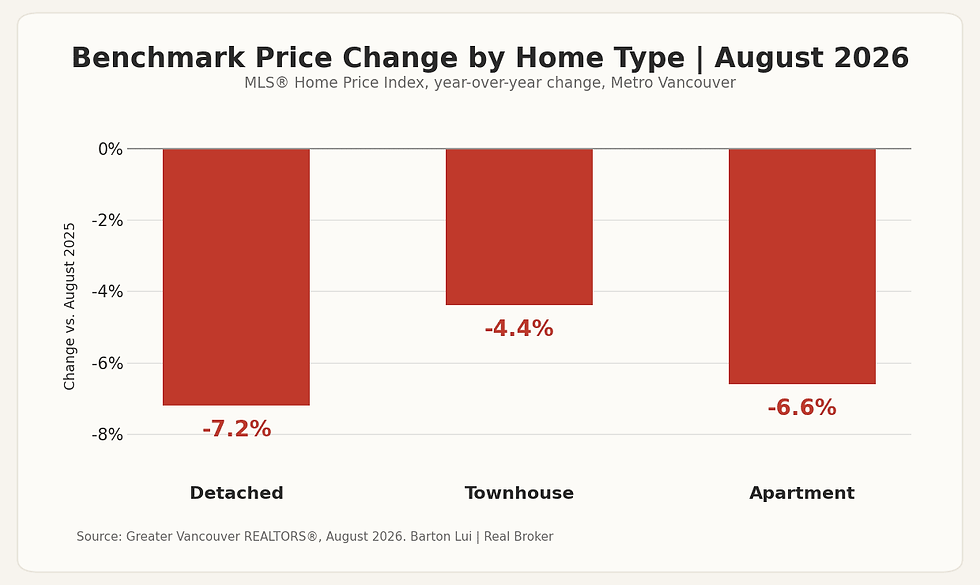
The sales-to-active listings ratio explains it. It was 12.3% in August, down from 14.6% in June. GVR's own research says prices face downward pressure when that ratio sits below 12% for a sustained stretch. Detached is already there at 9.6%. Attached is 15.1% and apartments 13.7%. Detached is the softest segment in the region right now, and its benchmark price is falling fastest.
Inventory is receding from a high base

Total active listings ended August at 15,798, down 2.7% from last August and down from the June high of 17,017. That's two straight months of decline, and the gap to the 10-year average has narrowed from 38% in January to 26.2% now. New listings came in at 4,100, down 3% year over year and slightly below the 10-year average for the first time this year.
Sellers are pulling back. But 26% above normal is still a lot of standing inventory, and demand fell faster than supply did. Inventory shrank. Buying shrank more.
The Bank of Canada held its rate again
The policy rate stayed at 2.25% on September 2, the same morning GVR published the August numbers. That's seven holds in a row. The rate hasn't moved since late 2025.
Inflation is why. It's running near 3%, above the Bank's 2% target, and Governor Tiff Macklem named US tariffs and the war in Iran as risks that could push rates either way. The next decision is October 28, and markets put the odds of another hold above 94%.
So if you've been waiting for cheaper money before you move, nothing changed this week. GVR's economist made the same point from the housing side, saying rates "aren't low enough to incentivize robust buying activity." I don't see a cut coming in time to change this fall.
My take on what comes next
In July I said prices would stay flat while buyers absorbed the inventory on the market. I got the direction wrong on both counts: sales fell, and prices went down rather than sideways. The reason I gave still holds. There is too much supply relative to demand.
I expect prices keep drifting down through the fall. Falling inventory isn't the same as tight inventory. We're coming off a high base, and roughly 4,000 presale units are still competing for the same shrinking pool of buyers, on top of everything listed for resale.
Population was the other thing I flagged in July. I said fewer new households would quietly pull housing demand lower over the next few years. This month GVR's economist named the slowdown in immigration to our region as one of the main drivers of this soft market, along with reduced investor demand.
That's a softer claim than mine. Slower immigration means slower growth, not a shrinking population. The direction is the same, and I think that pressure builds from here. Renewed trade tension with the US is real. I'd weight it well below the demographic change.
What this means for you
If you're buying: this is the strongest negotiating position buyers have had all year, and it's strongest in detached. A 9.6% sales-to-active ratio means sellers in that segment are competing hard for a small number of buyers. You have selection and room to ask.
If you're selling: pricing to June's market is the mistake I'm watching people make. The benchmark came down about $17,000 in two months. Homes priced off summer comparables are the ones sitting.
Ample selection, softening prices, and stable mortgage rates are considered favorable buying conditions, but they haven't been enough to bring many buyers off the sidelines. Andrew Lis, GVR Chief Economist
Every neighbourhood and situation is different. Your timeline and budget are your own. If you're weighing a move in Metro Vancouver and want a straight read on what August's numbers mean for you, reach out or give me a call. I'm always glad to help.
Warm regards,
Barton Lui, Realtor
Real Broker
604-715-5568

Comments